Sunday, October 16, 2011 in , , , , ,

The International: Movie Analysis applying neoliberalist policies


The International: Movie Analysis applying neoliberalist policies


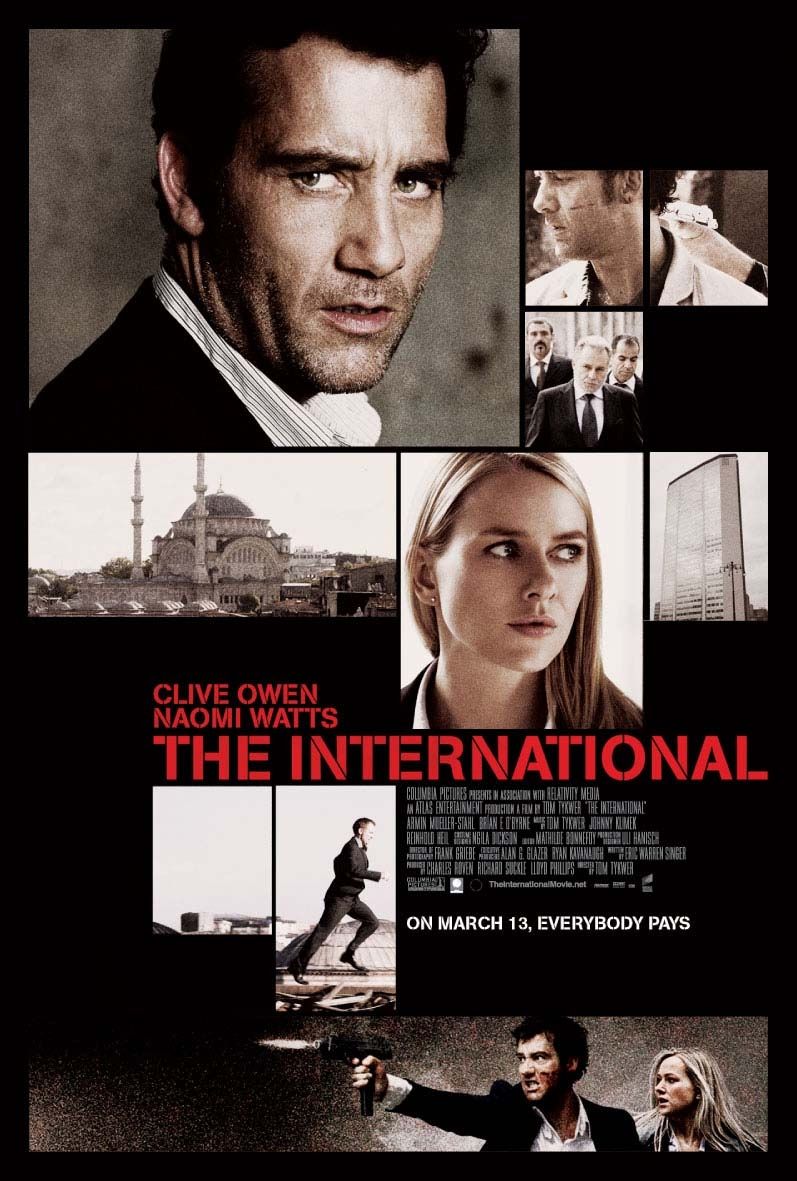
The International, starring Clive Owens and Naomi Watts
(directed by Tom Tyker)

MOVIE REVIEW with political analysis: 

In the movie “The International”, Interpol agent Salinger and his partner, New York Assistant D.A Whitman, are consistently stonewalled by local law enforcement in their attempt to close in on the bank’s insiders. They uncovered that I.B.B.C, an international bank, is buying large amount of weapons, and which it then sells to some terrorist organizations. The bank is involved in certain illegal activities such us money laundering, arms trading and destabilization of governments. The IBBC is trying to become the world’s bank that all terrorist and third-world nations use when shopping for ill-gotten weapons. But since the IBBC’s network of assassins and corrupt officials remains elusive, that justice comes mostly in the form of stale platitudes. According to Sallinger “Sometimes a man can meet his destiny on the road he took to avoid it.” The plot seems perfectly suited to the dire financial times in which we live in, the opportunity is lost in what amounts to a competent thriller that becomes less plausible as it progresses. The plot of the film is plausible because international banks, such as the World Bank, and IMF, have the capability to control how a government could leads its people through the programs and rules that they make for some countries that borrow money in their banks. The IBBC is also described by Calvini as bank, which have the objective to control the debt that the conflict produces. According to Calvini, if you control the debt, you control everything. When we look at our present economy at the moment, we can see this is already happening. Banks are controlling the debts of third world countries, like the Philippines for example. The Philippines has gained enormous amounts of debt from the IMF, and so that the government could borrow more, the Philippine Government blindly follows the neoliberalist policies of the IMF, even though these policies may not benefit the country. The movie presented an international bank that does not only control the money of the people, but also controls the government. They control their lives, and as a result everybody pays. The very essence of the banking industry, to make us all, whether we be nations or individuals slaves to debt.

Characteristics of Public Administration in a democratic institution

Characteristics of Public Administration in a democratic institution

Principles at the heart of good governance are participation, pluralism, subsidiarity, transparency, accountability, equity, access, partnership, and efficiency. The essence of public administration as a democratic institution is to use the principles of good (democratic) governance to design and structure state institutions, their internal processes and mechanisms, and their mission. Simply stated, it implies that public administration as a democratic institution has the following characteristics:

  • It is accountable and transparent

“In the words of Francisco S. Tantuico Jr., former chairman of the Commission on Audit of the Philippines: “Public accountability is the foundation of integrity. It cuts to the soul of government. It unmasks the government of the day of whatever façade it wears.” The Constitution of the Philippines describes public accountability thus:

Public Office is a public trust. Public Officers and employees must at all times be accountable to the people, serve them with utmost responsibility, integrity, loyalty and efficiency, act with patriotism and justice and lead modest lives.”(Briones Leonor)...

  • It is decentralized

Ø The Philippine Government is decentralized the legislation of the Local government code of 1991, whereas the legislation gave lgu units responsibility for basic services in health, agriculture, public works, and social welfare and environment and natural resources.

  • It is instrumental in ensuring fair and legitimate elections

Ø Various departments are held incharge to make sure that there will be fair and legitimate elections, such as comelec...The various departments in the government sometimes help to conduct the election to be fair and legitimate...Elections may be insufficient, but they are a necessary and essential element of democracy. By allowing certain government posts to be filled through the choices made by the electorate, elections function as a mechanism for determining the legitimacy of the political leadership, while at the same time guaranteeing the representational requirements of a modern democratic state. It is because of these characteristics that elections create opportunities, as minimum as they maybe, for altering the status quo and serve as a vehicle for political change.

  • It is based on a system of checks and balances between the executive branch and the judiciary and legistlative.

Ø The principle of the separation of powers has been adopted in the Philippines in order to avoid arbitrary rule and abuse of authority. The so called checks and balances among the three major departments of the government -executive, legislative and the judiciary – are no more than means of control by each and upon each of the departments. It is the duty of the departments to exercise moderation in their dealings with one another and their treatment of the public interest.This principle was instituted in the Philippine constitution for the purpose of impeding each branch from trespassing and seizing the power vested to others. Moreover, the provisions of the constitution in establishing limitations on the exercise of government authority also provide means of moderation

  • It plays a central role in combating exclusion and protecting the rights of minorities and disadvantaged groups

Ø Government activities undertaken to protect society as a whole. This includes national defense, protective services like police, fire and jail, education and environment.

Ø The government protects the rights of the minorities and disadvantaged groups through various executive orders that is instituted, like the laws that protects the lands, of various ethnic groups, and minorites

  • It has adequate management capacity to enhance access to justice;

Ø Free access to courts are not denied to any person by reason of poverty..The government make sure that the people are not deprived of their rights especially when they are facing criminal case, civil case,etc..

  • It protects public goods

Ø The pursuit of the public good by enhancing civil society, ensuring a well-run, fair, and effective public service are some of the goals of the field.

Ø Government activities are desinged to provided assistance to economic, pressure, and social groups.

  • It provides a facilitating environment for the active engagement and role of civil society and the private sector

Ø There government should not passed laws abridging the freedom of speech, of expression, or of the press, or the right of the people peaceably to assemble and petition the government for redress of grievances.

Ø Government activties undertaken to regulate

  • It utilizes the power of information and communication technology to promote citizens’ access and participation in the development proces

1. Article 3, Bill of Rights, Section 7: The right of the people to information on matters of public concern shall be recognized. Access to official records, and to documents and papers pertaining to official acts, transactions, or decisions, as well as to government research data used as basis for policy development, shall be afforded the citizen, subject to such limitations as may be provided by law”

  • It promotes and strengthens partnerships of various types to achieve objectives.

Ø This characteristics is evident in the various politcal parties, interest groups and pressure groups in the Philippines....

Structural Features

1. hierarchal structure of authority

2. creation of subunits based on differ nation of functions or specialization

3. recruitment and promotion based on merit and competence

4. a system of rules and procedures to guide action in the organization.

Source:

Ø United Nations (2007). PUBLIC ADMINISTRATION AND DEMOCRATIC GOVERNANCE: Governments Serving Citizens. 7th Global Forum on Reinventing Government. Building Trust in Government 26-29 June 2007, Vienna, Austria

Ø Briones Leonor. Public Financial Accountability for Integrity and Results: The Case of the Philippine Bureau of the Treasury

Ø 1987 Phillippine Constitution

Ø Tendero, Avelino (2000). Theory and Practice of Public Administration in the Philippines.Fiscal Administation Foundation Inc. (FaFI): Mandaluyong, Metro Manila.

Ø De Guzman, Raul P. Is there a Public Administration

Friday, March 26, 2010 in ,

POLITICAL INSTITUTIONS AS BASIC FUNDAMENTAL PROTECTION OF MAN

POLITICAL INSTITUTIONS AS BASIC FUNDAMENTAL PROTECTION OF MAN

John Locke is among the most influential political philosophers of the modern period. In the Two Treaties of Government, he claimed that men by nature and free and equal against the “divine right theory” claims that God had made all people naturally subject to a monarch. Locke argued that people have rights, such as the right to life, liberty, and property that have a foundation independent of the laws of any particular society. The social contract, where in the people in the state of nature agrees to transfer some of their rights to the sovereign such as the government to insure of protection of their properties, lives, and liberties. According to him if the government fails to promote the public good, it can be resisted and replaced with a new government by revolution. Locke also defends the principle of majority rule and the separation of legislative and executive powers.

Man is considered as a human being; therefore he/she has the capacity to exists as rational and free within their expected societal acceptance. By nature man is capable of understanding the “causes and effect” of their actions, as Lock claimed that “all men by nature are equal”, that is to say that everyone has an equal right to his / her own freedom without being subjected to the will or authority of another. We are all governed by “the law of reason”, in which “Law” is not so much limited as the direction of a free and intelligent agent to his proper interest. Thus self-government according to the law of reasons is necessary for human freedom. This freedom of man, and the liberty of acting according to his own will is grounded on his having reason, which able to instruct himself in “Law”. As men multiply, there is a need to for us to create a vital form of control in setting up societies, various institutions in order to preserve peace, liberty, justice. The political institutions as the basic fundamental institutions for man’s survival, we must support and utilize it in a proper manner. Man needs political institutions to exist as rational and free, because it is need to protect the basic fundamental rights of people, property, and etc. Without the existence of political institutions, man will lead to chaos and revolution. Man could live rational and free by nature, but if where are living in the group or society, we need as a set of institutionalized form of control such as laws, that will our protect and preserve our “life, liberty, and pursuit of happiness.” In order, to balance the competing the interest, institutions are created for fair and justifiable lifestyle. But in the modern world, as there is the existence of society such as state, must need institutional form of control.

Reference:

1) Curtis, Michael (1976) The Great Political Theories V2. Haper Collins.

2) Santiago, Miriam Deffennsor (2003) History of Philosophy: The Great Political Thinkers (Philosphy Series, Vol 1) Central Professional Books, Inc: Quezon City

3) Eisenstein, Great Political Thinkers

in ,

A successful Ruler in Machiavelli’s Eyes

A successful Ruler in Machiavelli’s Eyes


Machiavelli is considered one of the great early modern analyzers of political power. For Machiavelli, a prince must have the following characteristics such as deceit, cunning and expedient in order to be a great leader. He believes that man must control his own destiny, not God(s) or society. In doing so, man is in effect now allowing “nature” to dictate his fate. He treats morality and religion simply as “a means to political ends.” One of his famous claims is that “the end justifies the means”, in which he says that in order for a prince / ruler to attain his goals for the “common good”, he must sacrifice something like people (war, violence), land, and etc. From Machiavelli's point of view, a prince's attitude toward power must be based on an understanding of human nature, which he perceived as basically self-centered. Political activity, therefore, could not be restricted by moral considerations. The prince acts on behalf of the state and for the sake of the state must be willing to let his conscience sleep. Machiavelli believes that in order to be a great leader, one must be too kind or generous, liberality, clemency, and mercy, for he might be think of one as weak. Machiavelli’s principles and ideals can be consolidated into three main mindsets. 1.) Men should either be caressed or crushed, 2.) You must be prepared to act immorally when it becomes necessary, and 3.) It is better to be feared than loved.

At present, the contemporary state of politics is more democratic and civilized. There is not much chaos as what Machiavelli present. His idea of an ideal ruler is still viable in our government; however some ideas presented needs to be changed. Although, some politicians use his political blueprints for success, but they never cease to be effective. An example would be President Bush’s application of “the ends justifies the mean” when he sent troops to Iraq. His actions might have stopped some atrocities that the terrorist might make, but it leads to more violence, conflict and etc. Indeed, only a part of the “ideal ruler” will work today, since it’s not as chaotic as Machiavelli presented in the “The Prince”. However, the “ideal ruler” is what we need today, in order to correct corrupt and abusive practices in the government. If a leader wants to follow what Machiavelli’s idea of a ruler, the leader must be take things at a time in order to become the ideal ruler. The “ideal ruler” that others perceived today might be the same and sometimes different from Machiavelli’s. They might perceive a great leader as just, “god-fearing”, charismatic, optimistic and etc. Although we have had some leaders that possess those qualities that Machiavelli said that a leader should have, they are not using this to be a great leader, but use their skills and abilities for their own interest only. “The Prince” would be nice training handbooks for future leaders; the ideas presented would help them be a great leader in a lot of ways. Using it might be great for countries that doesn’t have a strong government or have been The truth is Machiavelli is only being honest with what he have observed consistently to be true. The effect of his writing are still found today.

Sunday, January 24, 2010 in ,

List of Alleged Corruption Cases During the Administration of Pres. Gloria M. Macapagal-Arroyo

What is corruption?

Corruption is the misuse of entrusted power for private gain.

  1. NBN ZTE Scandal
  2. Millions of bribe money to Congressmen and Governors (October 2007)
  3. Cheating in 2004 Elections (Hello Garci)
  4. Joc Joc Bolante Case (Fertilizer Scam, P728 Million)
  5. Jose Pidal Bank Account (Unexplained Wealth, P200 Million)
  6. Nani Perez Power Plant Deal ($2 Million)
  7. Use of Road User’s Tax for Campaigning
  8. Billion Peso Macapagal Boulevard (Overprice of P532 Million)
  9. Juetengate (Illegal Numbers game kickbacks)
  10. Extra Judicial Killings
  11. Arroyo Moneys in Germany (Exposed by Senator Cayetano)
  12. General Garcia and Other Military Men
  13. Billion Peso Poll Automation contract (P1.3 Billion)
  14. Northrail Project($503 Million)
  15. Maguindanao Results of 2007 Elections (Zubiri, Bedol)
  16. NAIA-3
  17. Venable Contract (Norberto Gonzales)
  18. Swine Scam (Exposed by Atty. Harry Roque)
  19. P432-million fertilizer deal in 2003

Source:http://arroyocorruption.pbworks.com/